|
Lessons with Bazin: Six Paths to a Poetics
[October 2018] : David Bordwell : His writings reflect on the fundamental nature of film, its artistic resources, and its social and political effects. His original contribution to the tradition lay in his arguments for mechanical recording as a virtue, not a deficit to be overcome. Contrary to the dominant strain of the 1920s and 1930s, Bazin believed cinema’s essence to lie in its photographic capacity, its power to lay bare the phenomenal reality of the world. As a result, he argued that the “unfilmic” technique of the long take, conjoined to camera movement and depth of field photography, respected that reality. It was editing, the technique once held to be the supremely filmic technique, that introduced a level of artifice with which directors would have to contend. [read the essay]
A Celestial Cinémathèque? or, Film Archives and Me: A Semi-Personal History
 [September 2014] : David Bordwell : Baby boomers who think that they lived in the best of times can find evidence in my relation to film archives. I started studying cinema in the late 1960s, when university film programs began and archives were starting to open up to university researchers. Over my forty-plus years of visits, archives have undergone many changes and confronted many challenges. I feel privileged to have watched these difficulties rise and be met—the need for preservation and restoration, the debate about rescuing nitrate-based copies, the rise of home video and cable television, and the pressures of digital media. What I hope to offer in the essay that follows are some sketchy answers to questions that arise from my own, admittedly limited, encounter with the archive world. [read the essay] [September 2014] : David Bordwell : Baby boomers who think that they lived in the best of times can find evidence in my relation to film archives. I started studying cinema in the late 1960s, when university film programs began and archives were starting to open up to university researchers. Over my forty-plus years of visits, archives have undergone many changes and confronted many challenges. I feel privileged to have watched these difficulties rise and be met—the need for preservation and restoration, the debate about rescuing nitrate-based copies, the rise of home video and cable television, and the pressures of digital media. What I hope to offer in the essay that follows are some sketchy answers to questions that arise from my own, admittedly limited, encounter with the archive world. [read the essay]
Shklovsky and His “Monument to a Scientific Error”
[March 2014] : David Bordwell : Viktor Shklovsky was one of the foremost literary theorists and critics of the twentieth century. In becoming a leader of the school of thought called “Russian Formalism,” he exercised immense influence on modern conceptions of literature. He was also a journalist, a screenwriter, an experimental novelist, and a powerful voice against Stalinist oppression of literary culture. [read the essay]
Murder Culture: Adventures in 1940s Suspense
 [March 2013] : David Bordwell : In 1947, novelist Mitchell Wilson proclaimed: “Within the past ten years, we have been witnessing a new form of popular fiction—the story of suspense.” We are so used to this genre—many of our bestsellers are suspense thrillers—that it’s a little surprising to recall that once it was quite a new thing. On reflection, though, we might wonder: Was it really so new? Don’t all novels and short stories, indeed all narratives in popular media, depend on suspense? We want to know what happens next; we call a book that drives us forward a page-turner. But writers of the period began to distinguish this general sort of suspense from something more specific. [read the essay] [March 2013] : David Bordwell : In 1947, novelist Mitchell Wilson proclaimed: “Within the past ten years, we have been witnessing a new form of popular fiction—the story of suspense.” We are so used to this genre—many of our bestsellers are suspense thrillers—that it’s a little surprising to recall that once it was quite a new thing. On reflection, though, we might wonder: Was it really so new? Don’t all novels and short stories, indeed all narratives in popular media, depend on suspense? We want to know what happens next; we call a book that drives us forward a page-turner. But writers of the period began to distinguish this general sort of suspense from something more specific. [read the essay]
The Viewer’s Share:
Models of Mind in Explaining Film
[May
2012] : David Bordwell : We watch films with our eyes and ears, but we experience films with our minds and bodies. Films do things to us, but we also do things with them. A film pulls a surprise; we jump. It sets up scenes; we follow them. It plants hints; we remember them. It prompts us to feel emotions; we feel them. If we want to know more—the how, the secrets of the craft—it would seem logical to ask the filmmakers. What enables them to get us to respond so precisely? [read the essay]
Common Sense + Film Theory = Common-Sense Film Theory?
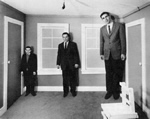 [May 2011] : David Bordwell : Start with this question, which I think is one of the
most fascinating we can ask: What enables us to understand films? All films?
Well, set aside some hard cases, like Brakhage abstractions and transmissions
of the Crab Nebula from the Hubble telescope (above). Let’s
start with a prototype: a film whose moving images present more or less recognizable
persons, places, and things caught up in what we intuitively call stories. In
other words, an ordinary movie shown in theatres and on video. [read the essay] [May 2011] : David Bordwell : Start with this question, which I think is one of the
most fascinating we can ask: What enables us to understand films? All films?
Well, set aside some hard cases, like Brakhage abstractions and transmissions
of the Crab Nebula from the Hubble telescope (above). Let’s
start with a prototype: a film whose moving images present more or less recognizable
persons, places, and things caught up in what we intuitively call stories. In
other words, an ordinary movie shown in theatres and on video. [read the essay]
Mad Detective: Doubling Down
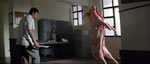 [November
2010] : David Bordwell : The camera tracks along a fearsome array of knives and cleavers. Cut to a young man, seen from behind, entering an office at Kowloon West police headquarters. Cut to a slow tracking shot that reveals a bulky, swaying shadow. A man backs into the frame holding a knife. The camera continues to glide until it provides a full view: a gigantic pig is hanging from the ceiling, and detective Bun lunges forward to stab it. Cut to show the young man, the novice cop Ho, staring at the spectacle along with other officers. The Mad Detective is tackling another case. [read the essay] [November
2010] : David Bordwell : The camera tracks along a fearsome array of knives and cleavers. Cut to a young man, seen from behind, entering an office at Kowloon West police headquarters. Cut to a slow tracking shot that reveals a bulky, swaying shadow. A man backs into the frame holding a knife. The camera continues to glide until it provides a full view: a gigantic pig is hanging from the ceiling, and detective Bun lunges forward to stab it. Cut to show the young man, the novice cop Ho, staring at the spectacle along with other officers. The Mad Detective is tackling another case. [read the essay]
The Classical Hollywood Cinema Twenty-Five
Years Along
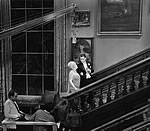 [September
2010] : David Bordwell, Janet Staiger, and Kristin Thompson :
This is a look back at a book that we wrote in the early 1980s and that was published
in 1985. For more on the book, and our rationale for posting this essay, see the
blog entry here. … Here is the opening of our book proposal: “What
we propose is not another study of an outstanding individual, a trend, or a genre.
The Classical Hollywood Cinema analyzes the broad and basic conditions of American
cinema as a historical institution. This project explores the common idea that
Hollywood filmmaking constitutes both an art and an industry. We examine the
artistic uniqueness and the mass-production aspects of the American studio cinema.” [read the essay] [September
2010] : David Bordwell, Janet Staiger, and Kristin Thompson :
This is a look back at a book that we wrote in the early 1980s and that was published
in 1985. For more on the book, and our rationale for posting this essay, see the
blog entry here. … Here is the opening of our book proposal: “What
we propose is not another study of an outstanding individual, a trend, or a genre.
The Classical Hollywood Cinema analyzes the broad and basic conditions of American
cinema as a historical institution. This project explores the common idea that
Hollywood filmmaking constitutes both an art and an industry. We examine the
artistic uniqueness and the mass-production aspects of the American studio cinema.” [read the essay]
William
Cameron Menzies: One Forceful, Impressive Idea
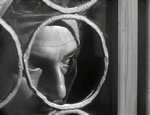 [March
2010] : David Bordwell : William Cameron Menzies was a wunderkind. He started working on films in 1919 when he was twenty-three; ten years later he won an Academy Award. By the time he died in 1956, he had participated in over seventy films. Why has nobody written a book about him? Don’t look at me. After several years sporadically tracking his career, I’m aware that this is a mammoth task. Here I want just to float some ideas about a filmmaker as distinctive, and sometimes as delirious, as Busby Berkeley. Like Berkeley, Menzies shows that a strong imagination can yank the screen away from weak directors. Like Berkeley, he shows that the studio system gave considerable leeway to flamboyant, even peculiar imagery, as long as it could be somehow motivated by story and genre. Just as important, he shows how exceeding the limits of that sort of motivation can seem daring, or maybe just cockeyed. [read the essay] [March
2010] : David Bordwell : William Cameron Menzies was a wunderkind. He started working on films in 1919 when he was twenty-three; ten years later he won an Academy Award. By the time he died in 1956, he had participated in over seventy films. Why has nobody written a book about him? Don’t look at me. After several years sporadically tracking his career, I’m aware that this is a mammoth task. Here I want just to float some ideas about a filmmaker as distinctive, and sometimes as delirious, as Busby Berkeley. Like Berkeley, Menzies shows that a strong imagination can yank the screen away from weak directors. Like Berkeley, he shows that the studio system gave considerable leeway to flamboyant, even peculiar imagery, as long as it could be somehow motivated by story and genre. Just as important, he shows how exceeding the limits of that sort of motivation can seem daring, or maybe just cockeyed. [read the essay]
Another Shaw Production: Anamorphic
Adventures in Hong Kong
 [October
2009] : David Bordwell : What did teenage viewers think when Kill Bill: Vol. 1 (2003)
opened with the logo for Shawscope? Could they possibly have shared the frisson
felt by baby-boomers who had haunted inner-city theatres thirty years before?
Or by viewers who had watched “Kung-Fu Theatre” on 1980s television?
Or by fanboys like Tarantino, freeze-framing cropped and trembling VHS tapes?
For all those generations, the Shawscope blazon opens onto a world of one-armed
swordfighters, beautiful woman warriors, and kung-fu masters with very long white
eyebrows. Without denying the peculiar pleasures of these sagas, we can peer
behind the logo and study this widescreen format’s place in a broader dynamic.
The Shaw mystique arose out of creative innovations of the studio’s personnel,
guided by the business policies of an all-powerful producer. We can as well analyze
how Shaw directors forged a distinct widescreen aesthetic—one that still,
as Tarantino seems to realize, has much to teach us about the ways movies can
seize spectators. Hong Kong took tutorials in widescreen from its neighbors,
but eventually it could offer lessons, and exhilarating ones, to the world. [read the essay] [October
2009] : David Bordwell : What did teenage viewers think when Kill Bill: Vol. 1 (2003)
opened with the logo for Shawscope? Could they possibly have shared the frisson
felt by baby-boomers who had haunted inner-city theatres thirty years before?
Or by viewers who had watched “Kung-Fu Theatre” on 1980s television?
Or by fanboys like Tarantino, freeze-framing cropped and trembling VHS tapes?
For all those generations, the Shawscope blazon opens onto a world of one-armed
swordfighters, beautiful woman warriors, and kung-fu masters with very long white
eyebrows. Without denying the peculiar pleasures of these sagas, we can peer
behind the logo and study this widescreen format’s place in a broader dynamic.
The Shaw mystique arose out of creative innovations of the studio’s personnel,
guided by the business policies of an all-powerful producer. We can as well analyze
how Shaw directors forged a distinct widescreen aesthetic—one that still,
as Tarantino seems to realize, has much to teach us about the ways movies can
seize spectators. Hong Kong took tutorials in widescreen from its neighbors,
but eventually it could offer lessons, and exhilarating ones, to the world. [read the essay]
Paolo Gioli’s Vertical
Cinema
[August 2009] : David Bordwell : The film
image has always been biased toward the horizontal. The classic 4:3 rectangle
has been the worldwide standard, and when it has varied, it has stretched lengthwise
(CinemaScope, Panavision). Within a shot, figures usually move laterally and
the camera swivels or travels accordingly. Apologists in the 1920s argued that
this horizontality was simply natural. Our eyes are mounted side by side, and
we have more eye muscles devoted to tracking objects on that axis than on the
vertical one. Further, the commentators argued, painters and other graphic artists
had long preferred the horizontal. [read the essay]
(Re)Discovering Charles
Dekeukeleire
[June 2009] : Kristin Thompson : The parentheses
in my title arise from the fact that Charles Dekeukeleire, a largely forgotten
Belgian experiment filmmaker of the late 1920s, had only small recognition in
his own day. Hans Scheugl and Ernst Schmidt, Jr., in their admirable reference
book, Eine
Subgeschichte des Films: Lexicon des Avantgarde-, Experimental-, und Undergroundfilms,
say of his films: “They were so advanced in their formal means, so far
ahead of their time, that they left behind the puzzled contemporary critics.” There
were in fact a few contemporary Belgian writers who discussed Dekeukeleire’s
films with insight, but certainly this minority response was not enough to insure
his work a place in cinema history after he turned to documentary filmmaking
in the 1930s. [read the essay]
Doing
Film History
[September 2008] : Nearly everybody loves movies. We
aren’t surprised that people rush
to see the latest hit or rent a cult favorite from the video store. But there
are some people who seek out old movies. And among those fans there’s
a still smaller group studying them. Let’s call “old movies” anything
older than twenty years. This of course creates a moving target. Baby boomers
like us don’t really
consider The Godfather or M*A*S*H to be old movies, but
many twentysomethings today will probably consider Pulp Fiction (1994)
to be old — maybe because they saw it when they were in their teens. Our
twenty-year cutoff is arbitrary, but in many cases that won’t matter. Everybody
agrees that La Grande Illusion from 1935 is an old movie,
though it still seems fresh and vital. Now for the real question. Why would anyone
be interested in watching and studying old movies? [read the essay]
The
Hook: Scene Transitions in Classical Cinema
[January 2008] : How do movies carry us from scene to
scene? The question is simple, but not many people have explored it. I’m
especially interested in how transitions are managed in mainstream, mass-audience
movies, but I’ll
have some things to say about other traditions too. I’ll also be talking
a lot about unity, which can make the whole exercise seem fairly old-fashioned
and Aristotelian. Yet examining how films create internal patterns reminds us
that those patterns are almost always aimed at the audience. We’re supposed
to register those patterns, consciously or not, and they prompt us to react in
particular ways. As so often, when we talk about form we’re actually talking
about the psychology of spectators. [read the essay]
Anatomy
of the Action Picture
[January 2007] : For a long time Kristin Thompson and
I have been interested in how films tell stories. We’re fascinated by the
principles that govern different storytelling traditions. For the sake of simplicity,
we’ve called the principles norms. The term implies a standard
of craft competence, along with a dimension of collective decision-making. Norms
are preferred alternatives within a tradition. A norm isn’t a single and
inflexible law; it’s best seen as a roughly bounded set of options. Within
any cluster of norms, there are always different ways to do anything. [read the essay]
Hearing Voices
[September 2006] : If you want your movie to fail, be sure to have an independent journalist publish a day-by-day account of its making. History is on your side. In Picture (1952), the founding entry in the genre, Lillian Ross followed the making of Huston’s Red Badge of Courage; the movie sank. Theodore Gershunny’s Soon to Be a Major Motion Picture (1980) expended 340 pages on Rosebud, one of Preminger’s biggest embarrassments. In The Devil’s Candy (1991), Julie Salamon chronicled the fiasco that was The Bonfire of the Vanities. Clearly, an outsider’s making-of book portends a flop. [read the essay]
Preface to the Croatian edition of On the History of Film Style
[August 2005] : Visual style was a major preoccupation of critics, theorists,
and filmmakers in the 1920s and thereafter, yet the study of it
unaccountably went out of favor at just the moment when it should
have been in full flower. As film studies entered the Western
academy in the 1970s, most scholars turned away from such
“aesthetic” concerns. Instead they promoted a
cultural/political framework for examining cinema, emphasizing a
symptomatic method of interpretation and a metapsychology derived
from psychoanalysis. The influence of this framework is still
being felt: Slavoj Žižek is continuing it, more
playfully but no less dogmatically. Today’s most influential
frame of reference, cultural studies, has continued the
anti-aesthetic tradition, replacing questions of artistic design
and effect with questions about audiences and broad cultural
processes. [read the essay]
Slavoj Žižek: Say Anything
[April 2005] : In The Fright of Real Tears: Krzysztof Kieslowski between
Theory and Post‑Theory (London: BFI, 2001), Slavoj Žižek makes some criticisms of my arguments
bearing on the history of film style. I reply to those criticisms
in the last chapter of Figures Traced in Light (pp. 260–264). But there is much more to say about FRT, and
this online essay supplements my remarks in Figures. [read the essay]
Film and the Historical Return
[March 2005] : An assembly of position papers in Cinema Journal,
“In Focus: Film History, or a Baedeker Guide to the
Historical Turn” (Cinema Journal 44, 1 [Fall 2004],
94–143) raises issues of continuing interest around how
historical research might be pursued. It seems to me, however,
that the collection offers as many grounds for discouragement as
for hope.
The letdown can partly be attributed to the contributors’
embrace of fairly fixed conventions of the symposium genre. The
essays carry an unhappy cargo of truisms. We should
“construct interdisciplinary discourse” (97); linear
narrative is bad; we should encourage non-westerners to write
histories of their cinemas; collaboration between scholars would
be good (but it carries risks). And, in case anyone has
forgotten, “history matters” (124). There’s also
the usual call to get with it, the announcement that we’re
tired of one thing and need a fresh departure (in particular,
what the writer is currently working on). It’s time to
discard old habits. For Richard Abel, the primary question of
historical research is, “Where next?” (107). “An
exclusive focus on gender should be passé,” the
collection’s editor Sumiko Higashi warns (97). Those who
believe that academic work in the humanities is driven by fashion
and a search for novelty at any cost will find some evidence here. [read the essay]
Studying Cinema
[2000] : People talk about the movies
they see, and some people write about those movies for newspapers and
magazines. How does film studies, as an academic discipline, accord with
these more common ways of talking and thinking about films? The two ways
of thinking about film aren’t completely distinct, I think, but some
differences are worth noting.
First, ordinary discourse about
cinema centers on evaluative talk. “That movie was great! I loved it!”
“Really? I didn’t think it was very good.” Likewise film reviewers take as
their primary goal the evaluation of films, giving thumbs up or thumbs
down, saying whether they regard them as worth the ticket price or not.
Academic film studies can involve evaluation, but for most film scholars
evaluating a particular movie isn’t, or isn’t always, the goal. [read the essay]
Annotated List of Principal Essays
|